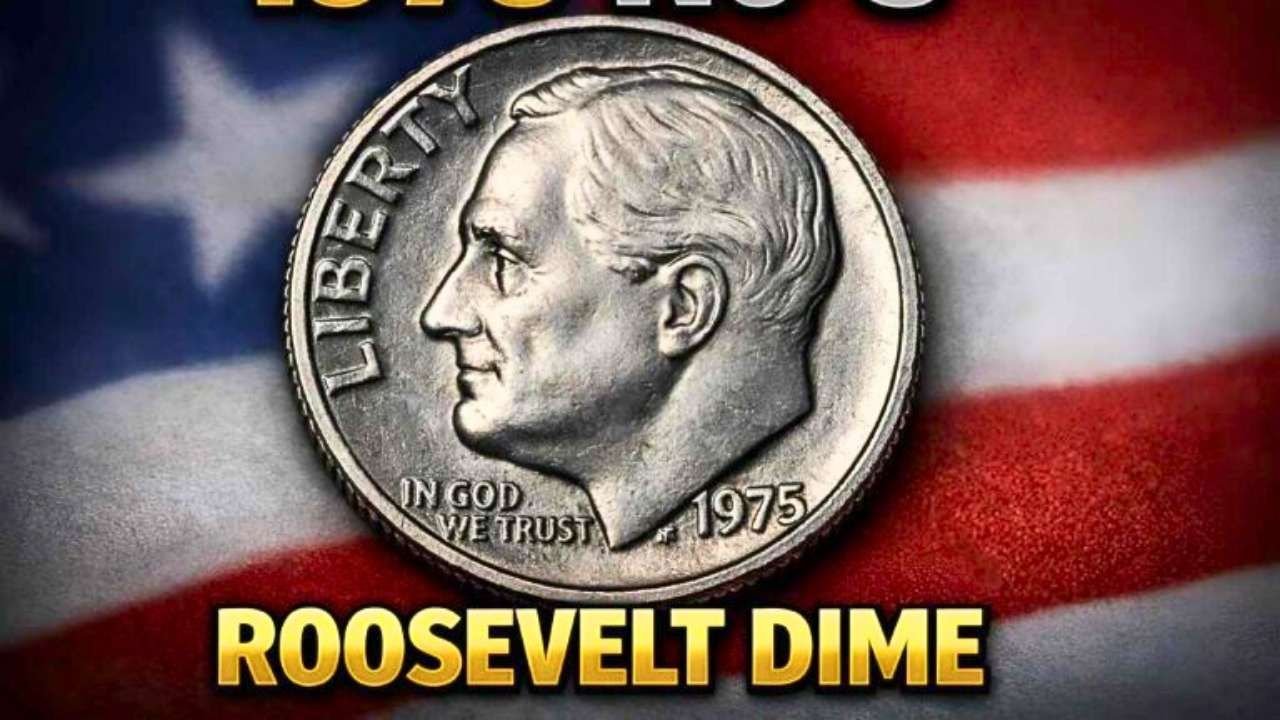
The Roosevelt Dime has been a cornerstone of American pocket change since 1946, honoring President Franklin D. Roosevelt and his legacy. While most dimes remain worth exactly ten cents, a select few have achieved near-mythical status in the numismatic world. None is more famous than the 1975 No-S Proof Roosevelt Dime — a modern rarity so scarce that only two confirmed examples exist.
In 2026, this elusive coin continues to command global attention, with collectors and investors alike recognizing it as one of the most extraordinary minting errors ever produced by the United States Mint.
The Origins of the Roosevelt Dime
The Roosevelt Dime replaced the Mercury Dime in 1946. Designed by Chief Engraver John R. Sinnock, the coin features Roosevelt’s portrait on the obverse and a reverse design showcasing a torch flanked by an olive branch and oak branch — symbols of liberty, peace, and strength.
For decades, the design has remained largely unchanged, making the series approachable for collectors. Yet beneath its familiar appearance lies a history of fascinating mint errors and rare proof varieties that have elevated certain dates to elite collector status.
Why the 1975 No-S Proof Is Unique
In 1975, proof coins were struck at the San Francisco Mint, and each proof coin was intended to bear the “S” mintmark. Proof coins are specially manufactured using polished dies and planchets, resulting in mirror-like surfaces and sharp details. They are produced specifically for collectors and sold in proof sets.

However, a remarkable error occurred: a small number of proof Roosevelt Dimes were struck without the “S” mintmark. Today, only two verified examples of the 1975 No-S Proof exist.
Because proof dies are carefully prepared and inspected, missing a mintmark at this stage is exceptionally rare. The absence of the “S” mintmark transformed what should have been an ordinary proof dime into one of the rarest modern U.S. coins ever produced.
Confirmed Examples and Auction Records
The two known 1975 No-S Proof dimes were discovered in original proof sets. Their authenticity has been verified by leading grading services, and both coins have achieved elite proof grades.

One example sold at auction for a record-breaking sum exceeding $450,000. Market analysts suggest that in today’s premium collectibles environment, a top-grade specimen could command significantly higher figures, potentially approaching or surpassing the million-dollar threshold depending on demand.
Although speculative headlines sometimes inflate values dramatically, serious collectors focus on verified auction results, grading certification, and long-term market performance.
Other Valuable No-S Roosevelt Dimes
The 1975 error is not the only missing mintmark variety in the series. Other No-S proof dimes have also captured attention.
1968 No-S Proof
One of the earliest modern proof mintmark errors, the 1968 No-S Proof is scarce and highly collectible. High-grade examples frequently trade in the five-figure range.
1970 No-S Proof
Another rare proof error, the 1970 No-S dime is believed to exist in slightly greater numbers than the 1975 variety, yet it remains extremely valuable and tightly held by collectors.
These coins demonstrate how a small detail — or the absence of one — can dramatically alter a coin’s financial trajectory.
The 1983 Doubled Die Reverse
Beyond missing mintmarks, the Roosevelt Dime series includes notable doubled die varieties. The 1983 Doubled Die Reverse shows visible doubling in the reverse lettering, particularly in inscriptions such as “ONE DIME.”
Unlike the ultra-rare 1975 No-S Proof, this variety was released into circulation. Well-preserved examples in Mint State condition can command hundreds or even over a thousand dollars, depending on eye appeal and grade.
Condition: The Ultimate Value Driver
For collectors and investors, condition is paramount. Coins are graded on a 70-point scale, with proof coins labeled “PR” and circulation strikes labeled “MS” (Mint State). A one-point difference at higher grades can significantly impact value.
A standard Roosevelt Dime in average circulated condition is worth face value. However, an MS-67+ example with exceptional luster and minimal marks may command a meaningful premium.
For ultra-rare varieties like the 1975 No-S Proof, elite grades such as PR-67 or higher amplify rarity even further. Professional authentication is essential for any coin suspected to be a rare error.
How to Identify a No-S Proof Dime
Collectors searching for valuable varieties should focus on a few key factors:
Check for the mintmark beneath the date. On proof dimes from San Francisco, the “S” mintmark should be clearly visible. Its absence on a proof coin from the relevant year is the defining feature of a No-S error.
Examine the finish. Proof coins have mirror-like fields and frosted devices. A circulation strike without a mintmark is not the same as a No-S proof.
Inspect for sharp detail and squared rims, both common characteristics of proof production.
When in doubt, submit the coin to a reputable third-party grading service for authentication.
Collecting Trends in 2026
In 2026, modern error coins are experiencing renewed interest. A younger generation of collectors, empowered by digital marketplaces and social platforms, is driving demand for visually dramatic and historically intriguing pieces.
The 1975 No-S Roosevelt Dime occupies a unique position at the intersection of rarity, storytelling, and investment-grade scarcity. With only two known examples, it competes with legendary American rarities in terms of exclusivity.
As high-net-worth collectors diversify into tangible assets, elite coins are increasingly viewed as portable stores of value. While not without risk, trophy-level numismatic pieces often hold appeal during periods of economic uncertainty.
Investment Perspective: Rarity Over Hype
While sensational claims sometimes circulate about astronomical valuations, disciplined collectors rely on verified sales data and population reports. The true strength of the 1975 No-S Proof lies not in exaggerated headlines, but in its documented scarcity.
Two confirmed examples. That fact alone defines its importance.
For investors, the lesson is clear: genuine rarity, strong provenance, and certified condition matter far more than speculation.
Final Thoughts
The 1975 No-S Roosevelt Dime stands as one of the most remarkable minting errors in modern American coinage. What began as a simple oversight at the San Francisco Mint evolved into a multimillion-dollar legend within the collecting community.
From its historical connection to President Roosevelt to its breathtaking rarity, this coin proves that even the smallest denomination can carry extraordinary value. Whether you are a seasoned numismatist or an emerging collector exploring premium tangible assets, the story of the 1975 No-S Proof is a powerful reminder that hidden treasures sometimes exist in the most unexpected places.