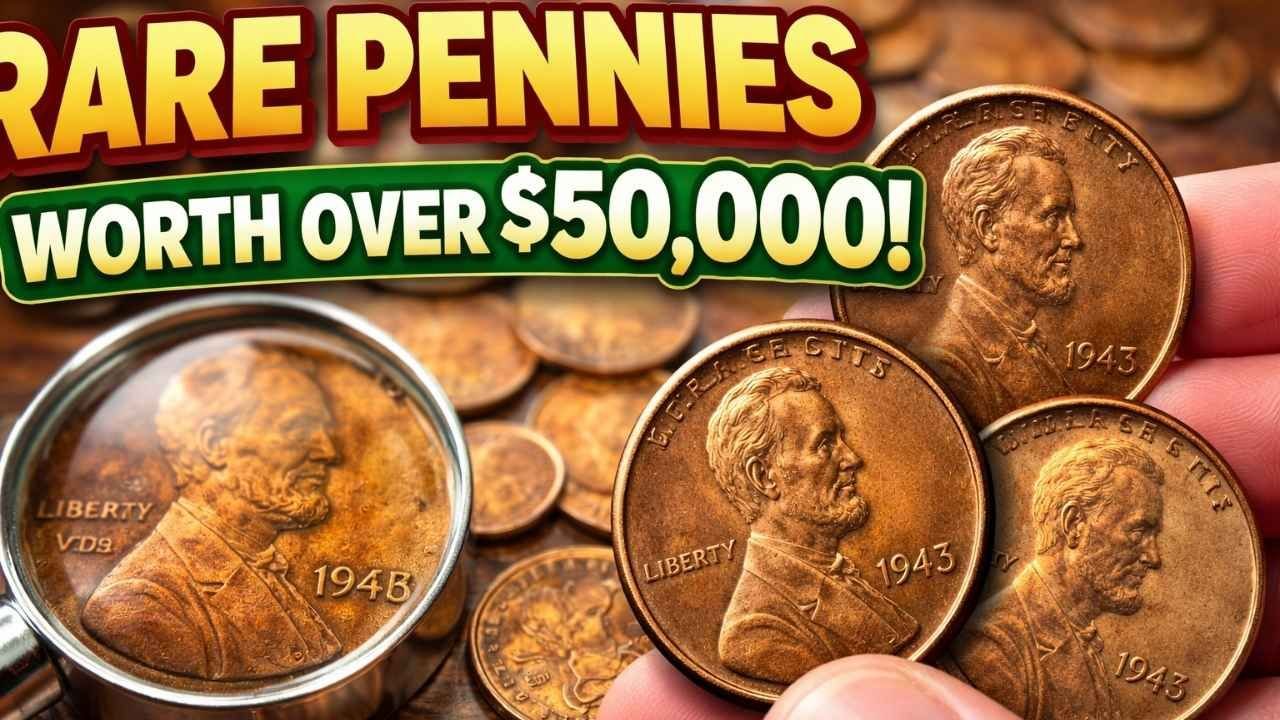
The idea that a single penny could be worth more than a luxury vehicle may sound improbable. Yet in the refined world of high-end numismatics, certain one-cent coins have consistently crossed the $50,000 threshold — and in some cases, far beyond.
In 2026, rare pennies remain one of the most dynamic segments of the U.S. coin market. Driven by scarcity, historical relevance, and intense collector demand, these small copper discs have evolved into serious alternative assets. If you own old coin jars, inherited collections, or vintage albums, understanding what to look for could prove financially transformative.
Below are ten American pennies that have sold for over $50,000 and continue to command strong premiums.
What Makes a Penny Worth Over $50,000?
Extraordinary value typically requires a combination of:
- Extremely low surviving population
- Significant minting error or rare variety
- Historical importance
- Strong collector demand
- High professional grade
Authentication from respected third-party grading services is essential. Certified coins trade at substantial premiums because buyers trust verified condition and originality.
Now, let’s explore the elite tier of valuable pennies.
1. 1943 bronze Lincoln cent
During World War II, the United States Mint produced steel cents to conserve copper for military use. However, a few leftover bronze planchets from 1942 were accidentally struck with 1943 dies.
The result: one of the most famous mint errors in U.S. history.

Authentic examples have sold for well over $100,000, with top-grade specimens reaching several hundred thousand dollars. These coins do not stick to a magnet and weigh approximately 3.11 grams.
2. 1909-S VDB Lincoln cent
The first year of the Lincoln cent introduced the initials “VDB” for designer Victor David Brenner. Public controversy led to their quick removal.
The San Francisco issue had a low mintage of just 484,000 coins. High-grade Mint State examples regularly exceed $50,000, with premium specimens commanding significantly more.
This coin remains a foundational piece for serious Lincoln cent collectors.
3. 1955 doubled die Lincoln cent
One of the most visually dramatic errors ever produced, the 1955 doubled die features bold doubling on the date and inscriptions.
Unlike subtle varieties, this error is visible without magnification. Strong, uncirculated examples often surpass $50,000, and elite specimens have achieved even higher auction results.
Its unmistakable appearance makes it one of the most celebrated error coins in American history.
4. 1944 steel Lincoln cent
In 1944, the Mint returned to bronze production. However, a few steel planchets from 1943 were mistakenly used again.
These 1944 steel cents are extremely rare. Because steel is magnetic, testing is straightforward. Certified high-grade examples have sold for over $100,000.
This transitional error continues to attract aggressive bidding.
5. 1877 Indian Head cent
Widely regarded as the key date of the Indian Head series, the 1877 issue had low mintage and heavy circulation.
Finding high-grade survivors is exceptionally difficult. Mint State examples regularly exceed $50,000 and can climb far higher depending on eye appeal and certification.
Collectors pursuing complete Indian Head sets consider it indispensable.
6. 1922 No D Lincoln cent
In 1922, pennies were struck only at the Denver Mint. However, excessive die polishing caused some coins to appear without the “D” mintmark.
Authentic No D varieties with strong details and no visible mintmark have surpassed $50,000 in upper Mint State grades.
Careful authentication is crucial, as altered examples exist.
7. 1793 Chain cent
Among the first cents ever produced by the United States, the 1793 Chain cent features a reverse chain design symbolizing unity.
Public criticism led to a quick design change, making surviving examples historically significant. High-grade specimens routinely exceed $50,000 and often reach into six-figure territory.
Its importance in early American coinage ensures sustained elite demand.
8. 1914-D Lincoln cent
With a relatively low mintage and extensive circulation, the 1914-D is another key Lincoln cent.
High-grade certified examples frequently surpass $50,000, particularly those with strong luster and minimal contact marks.
Roll hunters and estate buyers continue to search for overlooked specimens.
9. 1931-S Lincoln cent
Produced during the Great Depression, the 1931-S had limited output.
Although some were saved by collectors, pristine examples remain scarce. Top-condition coins can approach or exceed the $50,000 mark in today’s market.
Condition sensitivity drives pricing for this issue.
10. 1969-S doubled die Lincoln cent
The 1969-S doubled die features dramatic doubling similar to the 1955 variety.
Early discoveries were initially questioned before being authenticated as legitimate mint errors. Strong certified examples have exceeded $50,000, with exceptional pieces achieving significantly more.
Counterfeit versions exist, making professional grading essential.
Quick Value Snapshot (2026)
While prices fluctuate based on grade and demand, these pennies generally trade in the following ranges:
- 1943 Bronze: $100,000+
- 1909-S VDB: $50,000+
- 1955 Doubled Die: $50,000+
- 1944 Steel: $100,000+
- 1877 Indian Head: $50,000+
- 1922 No D: $50,000+
- 1793 Chain: $50,000 to $250,000+
- 1914-D: $50,000+
- 1931-S: Near or above $50,000 in top grade
- 1969-S Doubled Die: $50,000+
Values depend heavily on certification level and eye appeal.
How to Identify Rare Pennies at Home
Begin by sorting pennies dated before 1960. Use magnification and examine:
- Date and mintmark
- Signs of doubling
- Metal color differences
- Magnetic response
- Weight using a precision scale
Never clean a coin. Cleaning permanently damages surfaces and significantly reduces value.
The Role of Professional Grading
For coins potentially worth five figures or more, third-party authentication is mandatory.
Grading services encapsulate coins in tamper-evident holders and assign numerical grades. The difference between Mint State 63 and Mint State 65 can represent tens of thousands of dollars.
Certified coins also perform better at major auctions and private sales.
Market Outlook in 2026
Rare pennies remain highly attractive in 2026 due to:
- Increased interest in tangible assets
- Expanding global auction participation
- Strong historical appeal
- Continued demand for certified rarities
Elite collectors increasingly treat key-date pennies as long-term stores of value rather than casual collectibles.
Final Thoughts
The notion that a one-cent coin could be worth over $50,000 captures the imagination — yet auction records confirm it is reality.
From wartime errors to early American issues and dramatic doubled dies, these pennies represent scarcity at its most compelling. For the informed collector, knowledge is leverage.
That overlooked coin jar may contain more than loose change. It could hold a rare piece of American history — and a remarkable financial opportunity.