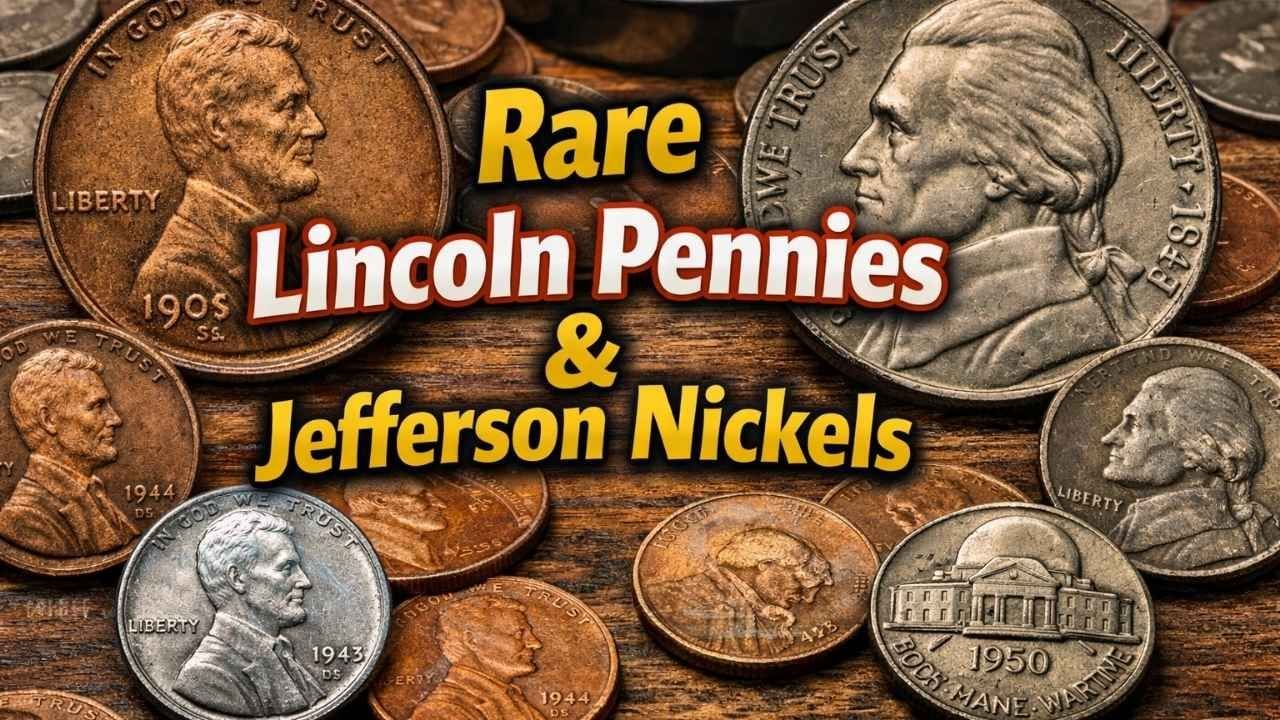
Coin collecting remains one of the few hobbies where history, wealth preservation, and discovery intersect in a tangible way. In 2026, rare Lincoln pennies and Jefferson nickels continue to command serious attention from collectors and investors alike. What makes these coins especially compelling is accessibility. They are not ancient relics locked away in museums — they are everyday American coins that still surface in circulation, estate collections, and forgotten jars.
With rising auction activity and renewed interest in tangible assets, key dates and error varieties within these two iconic series are seeing steady demand. This guide explores the history, standout rarities, grading essentials, and current 2026 value ranges every serious collector should understand.
The Legacy of the Lincoln Penny
Introduced in 1909 to commemorate the 100th birthday of Abraham Lincoln, the Lincoln cent marked a turning point in American coinage. It was the first regular-issue U.S. coin to feature a real historical figure rather than a symbolic representation.
Designed by Victor David Brenner, the coin originally displayed Brenner’s “VDB” initials prominently on the reverse — a detail that created one of the most famous key dates in U.S. numismatics.
Major Reverse Designs
Over more than a century, the Lincoln cent has evolved through several reverse designs:
- Wheat Ears (1909–1958)
- Memorial Reverse (1959–2008)
- 2009 Bicentennial Designs
- Union Shield (2010–Present)
Each era offers distinct collecting opportunities, but the Wheat series remains the most actively traded among high-value rarities.
The Story Behind the Jefferson Nickel
The Jefferson nickel debuted in 1938, replacing the Buffalo nickel. Featuring Thomas Jefferson on the obverse and his estate, Monticello, on the reverse, the design has remained largely consistent for decades.
Created by sculptor Felix Schlag, the Jefferson nickel is often overlooked. Yet certain dates, mint errors, and wartime compositions make select examples highly valuable in today’s market.
Why 2026 Is a Strong Year for Rare Coins

Several trends are shaping the 2026 coin market:
- Increased digital auction participation
- Greater awareness of mint errors
- Strong interest in physical asset diversification
- Expanding global collector base
While bullion prices influence baseline values, rarity and condition remain the primary drivers of premium coin performance.
Key Rare Lincoln Pennies and 2026 Value Ranges
Some Lincoln cents consistently attract competitive bidding. Approximate retail values as of 2026 are listed below:
1909-S VDB
- Circulated: $700–$1,500
- Mint State: $2,000–$4,000+
Low mintage and strong collector demand make this a cornerstone key date.
1914-D
- Circulated: $200–$800
- Mint State: $1,500–$3,000+
A classic scarcity from the Denver Mint.
1922 No D
- Circulated: $500–$1,200
- Mint State: $3,000+
A famous mint error where the “D” mint mark is missing.
1943 Bronze Cent
- Circulated: $100,000+
- High Grade: $250,000+
During World War II, cents were struck in steel to conserve copper. A few bronze planchets from 1942 were accidentally used, creating one of the most celebrated error coins in American history.
1955 Doubled Die
- Circulated: $1,000–$2,500
- Mint State: $3,000–$6,000
Bold doubling visible to the naked eye makes this error especially desirable.
1972 Doubled Die
- Circulated: $200–$500
- Mint State: $700–$1,500
A popular modern-era variety with strong collector recognition.
1992 Close AM
- Circulated: $500–$2,000
- Mint State: $3,000+
A subtle reverse design variety with dramatic value differences.
Valuable Jefferson Nickels to Watch
Jefferson nickels may appear modest, but certain examples are standout performers.
1939-D
- Circulated: $10–$50
- Mint State: $75–$300
An early key date with lower mintage.
1942–1945 Silver War Nickels
- Circulated: $2–$10
- Mint State: $15–$75
These contain 35% silver and feature a large mintmark above Monticello.
1943-P 3 Over 2
- Circulated: $300–$1,000
- Mint State: $2,000+
A dramatic overdate error highly prized by specialists.
1950-D
- Circulated: $10–$40
- Mint State: $50–$300
Low mintage, though many were saved in rolls.
1964 SMS (Special Strike)
- $8,000+ depending on grade
Extremely rare and controversial, believed to be experimental strikes.
1971 No S Proof
- $1,000–$2,500+
A rare proof error missing the San Francisco mint mark.
Understanding Mint Marks
Mint marks identify production facilities:
- No mint mark (older Philadelphia issues)
- D for Denver
- S for San Francisco
- P for Philadelphia on later nickels
A small letter can dramatically alter value. For example, a 1914 Lincoln cent without a mint mark is common, while the 1914-D is a major key date.
Error Coins: Small Mistakes, Big Premiums
Production errors remain one of the most exciting areas of modern collecting. High-value categories include:
- Doubled dies
- Overdates
- Repunched mint marks
- Off-center strikes
- Wrong planchet errors
Authenticated examples can sell for multiples of standard market values, especially in high grades.
How Grading Impacts Price
Condition is everything. A coin graded Mint State 65 can be worth exponentially more than the same date in Fine condition.
General grading tiers include:
- Good (G4)
- Fine (F12)
- Very Fine (VF20)
- Extremely Fine (EF40)
- About Uncirculated (AU50)
- Mint State (MS60–MS70)
Professional third-party grading enhances liquidity and investor confidence, particularly for coins valued above four figures.
Smart Identification Tips
Searching pocket change remains surprisingly productive. To maximize your chances:
- Inspect dates closely
- Verify mint marks
- Look for doubling in lettering
- Weigh suspicious 1943 cents
- Compare against verified high-resolution images
Patience and consistency often yield the best discoveries.
Investment Perspective for 2026
Not all coins are investments. Common dates in average condition typically see modest appreciation. However, certified key dates and dramatic error coins have shown resilient long-term growth.
Many experienced collectors diversify across multiple key issues rather than concentrating capital into a single high-priced coin. This approach balances risk while maintaining exposure to strong-performing segments of the market.
Storage and Preservation
Proper storage protects both grade and value:
- Use acid-free holders or capsules
- Store in a cool, dry environment
- Handle coins only by the edges
- Never clean or polish surfaces
Cleaning can permanently reduce value — even light surface alteration may downgrade a coin significantly.
Final Thoughts
Rare Lincoln pennies and Jefferson nickels prove that extraordinary value can hide in ordinary places. These coins connect collectors to American history while offering real financial upside when chosen wisely.
In 2026, knowledge remains the ultimate competitive advantage. Study key dates, learn to identify genuine errors, understand grading standards, and protect your collection carefully. Whether building a complete date set or targeting high-impact rarities, disciplined research and patience can transform everyday coins into meaningful assets.
Your next discovery may already be waiting in your collection.