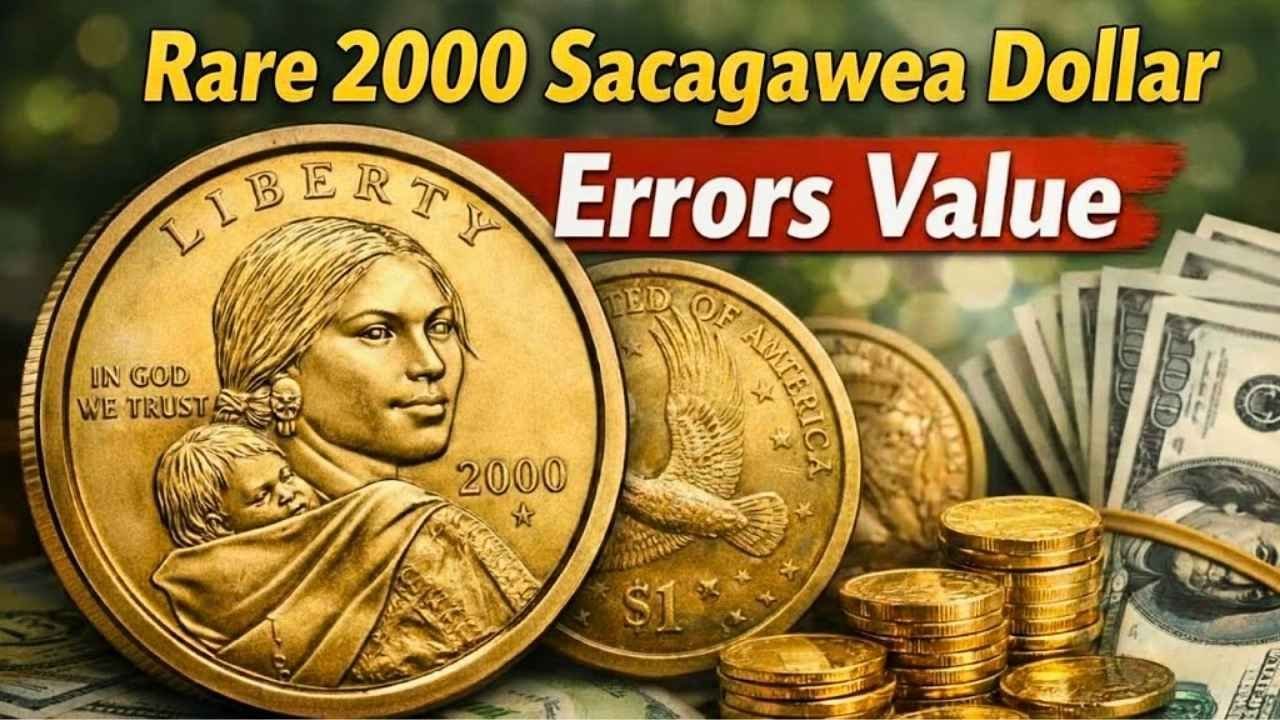
When the Sacagawea Dollar debuted in 2000, few imagined that certain versions of this modern coin would become some of the most talked-about treasures in contemporary numismatics. Created to replace the short-lived Susan B. Anthony Dollar, the new golden-colored dollar was meant to inspire public confidence and circulation use. Instead, while everyday pieces remain worth face value, select rare varieties have evolved into high-demand collector assets.
In 2026, the 2000 Sacagawea Dollar continues to command attention for its fascinating minting errors, limited promotional releases, and exceptional high-grade examples. For serious collectors and investors alike, these coins represent an intriguing blend of modern history and financial upside.
The Design That Sparked a New Era

The obverse of the Sacagawea Dollar features a portrait of Sacagawea carrying her infant son, Jean Baptiste. The reverse of the original 2000 issue displays a soaring eagle, symbolizing strength and freedom. The coin’s golden hue comes from a manganese-brass alloy, intentionally selected to distinguish it from the quarter and avoid the confusion that affected its predecessor.
Although the coin struggled to achieve widespread circulation, collectors quickly recognized that certain early releases and striking anomalies had significant potential.
Why Some 2000 Sacagawea Dollars Are Worth Thousands
Most 2000 Sacagawea Dollars found in circulation remain common. However, value increases dramatically when rarity, error status, or exceptional preservation enters the equation.

The most valuable examples fall into three major categories:
- Promotional varieties
- Major mint errors
- Ultra high-grade certified coins
Let’s examine the most significant ones commanding premium prices in 2026.
The Cheerios Dollar: A Modern Rarity
One of the most famous modern coin varieties is the 2000 “Cheerios Dollar.” As part of a promotional campaign, the United States Mint partnered with General Mills to place newly minted Sacagawea Dollars inside select boxes of Cheerios cereal.

At first glance, these coins appeared ordinary. However, years later, collectors discovered a subtle but important difference: enhanced detailing in the eagle’s tail feathers on the reverse.
This refined feather design was unique to the promotional release and never used in standard circulation strikes. Because only a limited number were distributed, authenticated Cheerios Dollars have sold for $5,000 to $25,000 in certified MS-65 condition, with higher-grade examples commanding even more.
For modern collectors, the Cheerios Dollar represents one of the most accessible five-figure coins of the 21st century.
The Mule Error: A Six-Figure Modern Icon
Perhaps the most dramatic Sacagawea Dollar variety is the mule error — a coin struck with mismatched dies.
In this case, the obverse of the Sacagawea Dollar was mistakenly paired with the reverse die of a Washington Quarter. The result is a hybrid coin featuring Sacagawea on one side and the quarter’s reverse on the other.
This error is extraordinarily rare, with only a small number confirmed. Because of its uniqueness and visual impact, collectors consider it one of the most important modern U.S. mint errors ever discovered.
Auction results have reached $50,000 to over $150,000, depending on condition and certification. For a coin minted in 2000, those numbers are remarkable.
High-Grade Circulation Coins: Condition Is Everything
Even standard 2000 Sacagawea Dollars can become valuable under the right circumstances.
Coins graded MS-67 or higher by leading professional grading services are surprisingly scarce. Modern coins are mass-produced, but maintaining flawless surfaces free from contact marks, scratches, and discoloration is exceptionally difficult.
An MS-67+ example can bring $100 to $1,000 or more, depending on market demand. While this may not match mule-error levels, it demonstrates how condition alone can transform an ordinary dollar into a premium collectible.
For investors who prefer lower entry points, high-grade modern coins present a strategic opportunity.
Proof Issues and Collector Sets
The United States Mint also produced proof versions of the Sacagawea Dollar specifically for collectors. These coins feature mirror-like fields and frosted design elements, creating a dramatic contrast known as cameo finish.
In top grades such as PR-69 or PR-70, proof coins typically trade between $50 and $500. While not ultra-rare, pristine proofs remain desirable due to their aesthetic appeal and limited mintages compared to circulation strikes.
Collectors building registry-quality sets often compete for the finest examples, pushing prices higher for perfect specimens.
Separating Fact from Hype
Stories occasionally circulate online claiming Sacagawea Dollars have sold for millions. While such headlines generate excitement, documented auction records confirm that most verified high-value examples fall within five- or six-figure ranges.
The true value of any coin depends on:
- Verified rarity
- Certified condition
- Documented provenance
- Market demand at the time of sale
Informed buyers rely on professional grading and established auction houses rather than sensational claims.
How to Identify a Valuable 2000 Sacagawea Dollar
If you come across a 2000 Sacagawea Dollar, examine it carefully under proper lighting.
Look for:
- Enhanced tail feather detail (Cheerios variety)
- Mismatched quarter reverse (mule error)
- Mirror-like surfaces (proof issue)
- Exceptional preservation with minimal marks
When in doubt, professional authentication is essential. Reputable grading services provide both certification and encapsulation, protecting the coin while establishing market credibility.
Market Trends in 2026
Modern coin collecting has experienced renewed energy in recent years. Online marketplaces, digital auction platforms, and social media communities have introduced a new generation to numismatics.
Younger investors, in particular, are drawn to modern rarities with compelling backstories. The Sacagawea Dollar fits that narrative perfectly — a contemporary coin with dramatic error discoveries and limited promotional varieties.
As wealth preservation strategies diversify beyond traditional assets, tangible collectibles like rare coins continue to gain relevance.
Smart Strategies for Collectors
For those interested in pursuing Sacagawea Dollar varieties:
Study reputable reference guides and auction archives.
Focus on certified examples to reduce risk.
Avoid heavily circulated pieces unless targeting rare errors.
Store coins in climate-controlled environments to prevent damage.
Track auction trends to understand real-time demand.
Patience and knowledge remain the foundation of successful collecting.
Final Thoughts
At first glance, the 2000 Sacagawea Dollar appears to be a simple modern coin. Yet beneath its golden surface lies a world of rarity, error discoveries, and high-grade scarcity that continues to captivate collectors in 2026.
From the coveted Cheerios Dollar to the dramatic mule error pairing with the Washington Quarter, these varieties demonstrate that even contemporary coins can achieve extraordinary status.
For the discerning collector, the opportunity is clear: hidden value still exists in modern mint issues. Sometimes, the next remarkable discovery is not buried in ancient history — it may be waiting in a coin jar, a forgotten set, or a promotional cereal box from decades past.