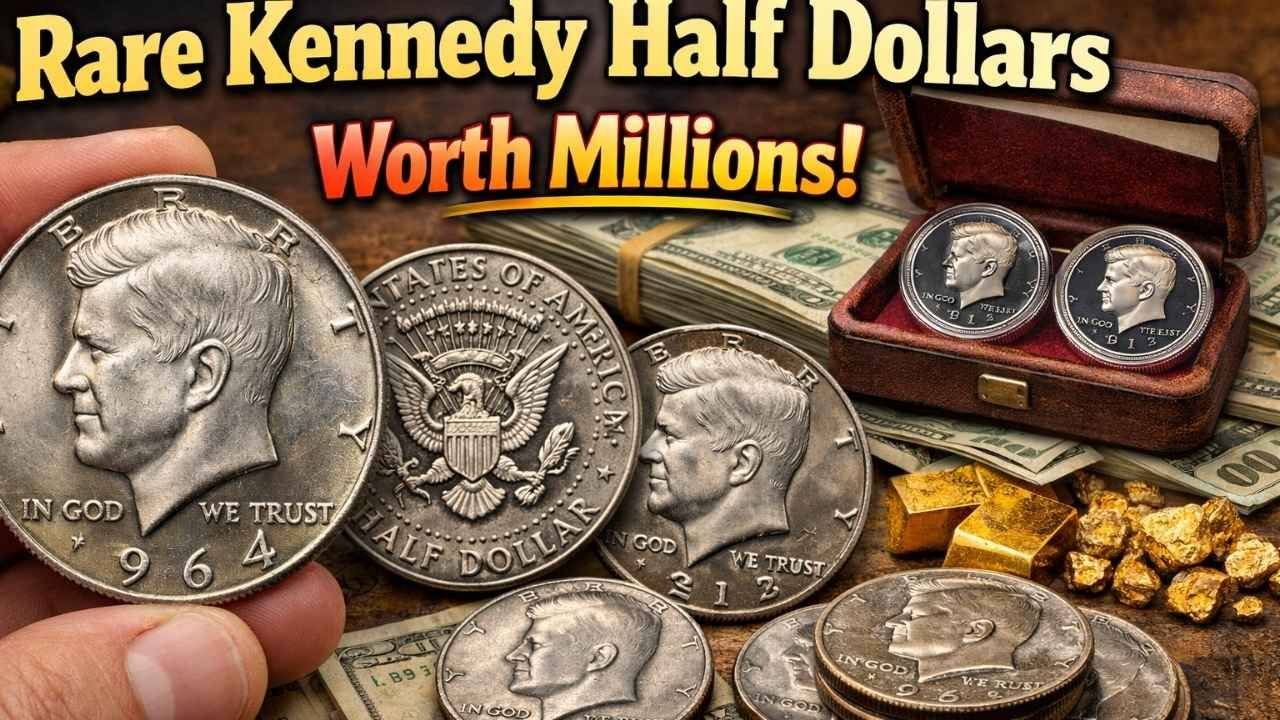
The Kennedy half dollar is more than a fifty-cent piece. Introduced in 1964 to honor President John F. Kennedy following his assassination, it quickly became one of the most widely saved coins in modern American history. Millions were pulled from circulation as keepsakes, yet within this familiar series lie rare varieties, special strikes, and elite-grade examples that have achieved six-figure auction results — and in exceptional cases, have approached the million-dollar threshold.
For collectors and investors in 2026, understanding what separates a common half dollar from a high-value rarity is essential. This guide breaks down identification, mint marks, silver content, key varieties, and the factors that drive extraordinary prices.
The Historical Foundation of the Kennedy Half Dollar
Following the events of November 1963, Congress moved rapidly to redesign the half dollar. The coin debuted in 1964 and was met with immediate public demand. Long lines formed at banks as Americans sought to preserve the coin as a national memorial.
The coin has been produced continuously since 1964 by the United States Mint, making it one of the longest-running modern U.S. coin series.
Composition changes play a major role in value:
- 1964: 90% silver
- 1965–1970: 40% silver
- 1971 onward (circulation): copper-nickel clad
- Select collector issues: special silver compositions
Understanding these shifts is fundamental when evaluating potential rarity.
Understanding Mint Marks and Where to Look
Mint marks identify where a coin was struck. On most Kennedy half dollars, the mint mark appears on the obverse below Kennedy’s neck truncation. On certain early issues, it appears on the reverse.
Primary mint facilities include:
- Philadelphia (no mint mark prior to 1980)
- Denver (D)
- San Francisco (S)

The mint mark alone does not determine rarity. Instead, scarcity emerges when mint location intersects with low production numbers, unique varieties, or exceptional condition.
Silver Content and Intrinsic Value
Silver composition adds baseline value to early Kennedy half dollars.
A circulated 1964 coin is worth more than face value simply due to its silver content. However, melt value is only the starting point. Condition dramatically impacts pricing. A heavily worn silver half dollar may trade near bullion value, while a flawless specimen graded at the top of the population report can command staggering premiums.
The 1964 Special Strike (SMS)
Among the most coveted Kennedy half dollars is the rare 1964 Special Strike, often called the 1964 SMS.
These coins are neither standard business strikes nor traditional proofs. They feature:
- Sharp, detailed devices
- Satin-like surfaces
- Distinctive die characteristics
Only a handful are confirmed to exist. Because of their extreme rarity and mysterious origin, authenticated examples have sold for well over $100,000, with top specimens reaching several hundred thousand dollars.
Their near-unique status positions them among the most important modern U.S. coin rarities.
The 1964 Accented Hair Proof
Another desirable early variety is the 1964 Accented Hair proof. Early proof dies displayed stronger hair detail above Kennedy’s ear before being modified.
Identification markers include:
- More pronounced hair strands
- A missing serif on the “I” in LIBERTY
- San Francisco “S” mint mark
While not a million-dollar coin, pristine, high-grade examples regularly sell for thousands and remain a staple for advanced proof collectors.
The 1970-D Kennedy Half Dollar
The 1970-D issue was never released for general circulation. Instead, it was available only in special mint sets.
Its limited distribution makes it a key date in the series. Most examples sell for modest premiums, but high-grade specimens with exceptional luster and minimal contact marks can command significantly higher prices. Registry-level coins graded at the very top of certification reports attract aggressive bidding.
Special Mint Set Coins (1966–1967)
During the mid-1960s coin shortage, traditional proof sets were suspended. Instead, the Mint produced Special Mint Sets with a unique finish that falls between proof and business strike.
Ultra-high-grade examples from these years are scarce. Coins graded at the highest certification levels have sold for tens of thousands due to their rarity in pristine condition.
The 1998-S Matte Finish Silver Issue
In 1998, a matte finish silver Kennedy half dollar was issued in a commemorative set honoring Robert F. Kennedy. With fewer than 65,000 produced, it is one of the lowest-mintage modern issues in the series.
Perfectly graded specimens have sold for several thousand dollars and continue to appreciate as collectors seek complete high-quality sets.
Major Error Coins That Command Premiums
Mint errors often generate the most excitement and financial upside.
Doubled Die Varieties
A doubled die occurs when the die receives misaligned impressions during hubbing. Visible doubling on lettering or numerals can significantly increase value, especially in Mint State condition.
Off-Center Strikes
Coins struck off-center show part of the design missing. Dramatic examples in strong condition can bring substantial premiums.
Wrong Planchet Errors
Occasionally, Kennedy half dollars have been struck on planchets intended for other denominations. These are rare and highly collectible.
Clipped Planchets
Curved or straight clips caused by improper blank cutting can increase value depending on severity and eye appeal.
Certified major errors have sold for thousands — and in exceptional cases, far more.
The Power of Professional Grading
Condition is often the single most important value driver.
Coins are graded on a 1 to 70 scale. At the upper end, even a one-point difference can mean thousands — or tens of thousands — of dollars.
The two most respected grading authorities are:
- Professional Coin Grading Service
- Numismatic Guaranty Company
Coins graded MS67, MS68, or higher are often registry-quality pieces that attract competitive bidding from elite collectors.
Can a Kennedy Half Dollar Be Worth Millions?
While no standard circulation Kennedy half dollar consistently sells for a full million dollars, ultra-rare special strikes and elite certified specimens have approached extraordinary figures.
Record prices are driven by:
- Unique or near-unique status
- Exceptional preservation
- Strong collector competition
- Verified provenance
As population reports shrink at the highest grades, competition intensifies. In modern numismatics, scarcity at the top tier fuels premium valuations.
How to Identify Valuable Kennedy Half Dollars
If reviewing your own coins, begin with these steps:
- Focus on 1964, 1970-D, and special collector issues
- Check for mint marks below the neck
- Examine luster and surface quality
- Inspect for doubling or striking anomalies
- Weigh coins to confirm silver composition
Never clean a coin. Cleaning permanently damages surfaces and reduces value.
Investment Outlook in 2026
Rare Kennedy half dollars occupy a unique space between historical collectible and tangible asset. Their connection to President Kennedy adds emotional resonance, while early silver issues offer intrinsic metal value.
For investors, the strongest long-term performers tend to be:
- Special strikes with low populations
- Elite-grade silver issues
- Verified major error coins
- Low-mintage collector releases
As interest in tangible assets grows, top-tier examples continue to attract affluent buyers.
Final Thoughts
The Kennedy half dollar remains one of America’s most recognizable coins. While most examples are common, a select group stands apart as modern rarities capable of commanding breathtaking prices.
From the 1964 Special Strike to dramatic mint errors and registry-quality silver issues, the series offers both historical depth and financial opportunity.
Careful examination, professional authentication, and disciplined collecting are the keys to uncovering value. What appears to be an ordinary half dollar may, under the right conditions, represent a remarkable and highly rewarding discovery.