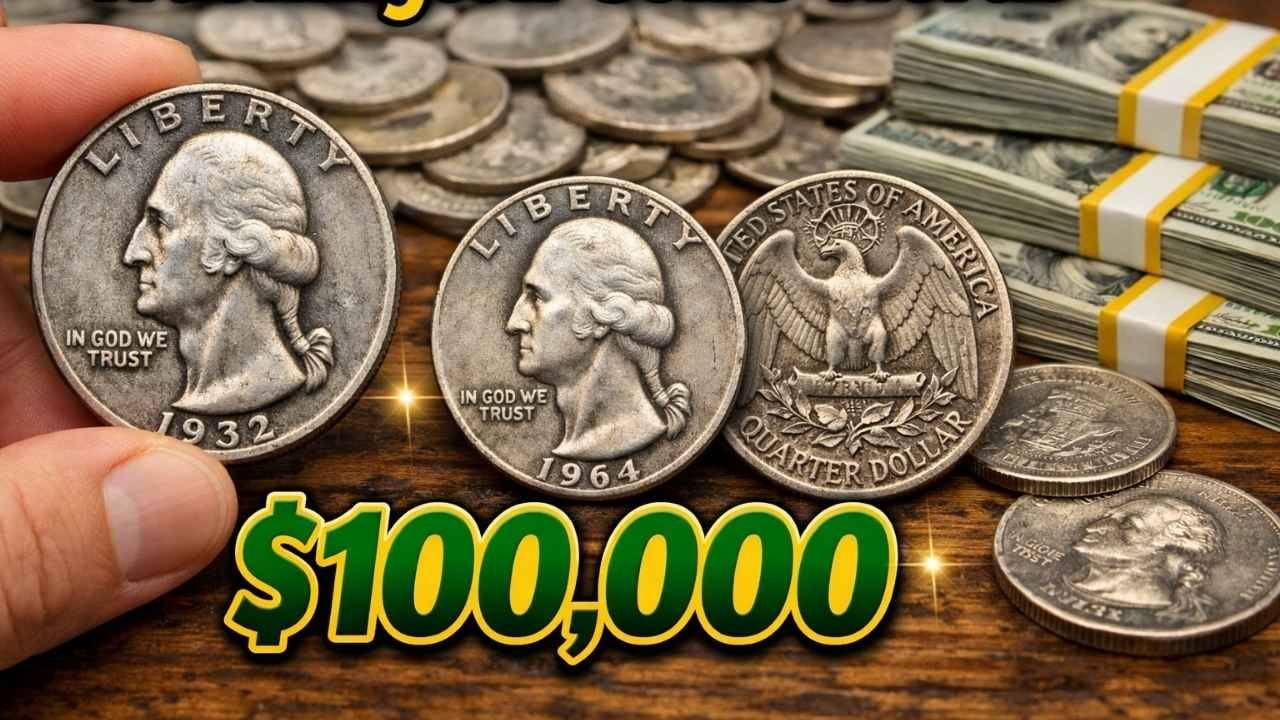
Coins honoring George Washington have defined American numismatics for generations. From early experimental issues struck around the birth of the nation to modern mint errors discovered by sharp-eyed collectors, Washington-themed coins continue to command global attention.
While millions of Washington quarters circulate daily, only a handful of elite examples have crossed the $100,000 threshold at auction. In 2026, demand for historically significant, condition-rarity trophies remains strong among advanced collectors and investment-focused buyers.
Below are five ultra-rare Washington coins that have achieved six-figure results — and in some cases, far more.
The Enduring Appeal of Washington on U.S. Coinage
Washington first appeared on circulating U.S. coinage in 1932 with the debut of the Washington quarter, issued to commemorate the 200th anniversary of his birth. Since then, his portrait has become one of the most recognized designs in American currency.
Beyond circulating quarters, Washington has appeared on commemorative silver dollars, gold coins, and early pattern issues. The coins that command six-figure premiums typically share one or more defining traits:

Extremely low surviving populations
Exceptional certified condition
Historical importance
Documented auction performance
Let’s explore the five standouts.
1. 1932-D Washington Quarter
The 1932-D quarter is widely considered the key date of the Washington quarter series. Struck during the Great Depression at the Denver Mint, it had a relatively modest mintage of just over 400,000 pieces.

Although that number may not seem extraordinarily low, most examples entered heavy circulation. As a result, high-grade survivors are scarce.
In circulated grades, the coin is valuable but accessible. However, in Mint State grades above MS66, scarcity becomes dramatic. Registry-quality specimens certified by leading grading services have sold for well over $100,000.
Why it matters:
First year of issue
Low mintage
Intense demand from advanced collectors
The small “D” mint mark appears on the reverse beneath the wreath on early Washington quarters. Strong detail in Washington’s hair and minimal contact marks are critical indicators of high value.
2. 1932-S Washington Quarter
Often paired with its Denver counterpart, the 1932-S quarter from San Francisco is another foundational rarity.
Although its mintage was slightly higher than the 1932-D, survival rates in top condition remain extremely low. Most examples saw heavy commercial use during the economic hardships of the 1930s.
In superb Mint State grades, especially MS67 and above, auction prices have comfortably crossed the $100,000 mark.
Collectors assembling complete Washington quarter sets must secure both 1932 key dates. This consistent demand ensures that pristine examples remain highly competitive at major auctions.
When evaluating a potential 1932-S:
Confirm the clear “S” mint mark on the reverse
Look for original, uncleaned surfaces
Examine eagle feather detail for strike quality
Professional certification is essential for coins appearing uncirculated.
3. 1776 Continental Dollar (Washington Association)
Although not a federal issue, the Continental Dollar holds a legendary place in early American numismatics. Struck in 1776, these pieces predate the establishment of the U.S. Mint.
Certain varieties bear inscriptions and motifs closely associated with the Revolutionary era, and tradition links the coin symbolically with Washington’s leadership during the founding period.
The origins of the Continental Dollar remain debated among historians, which only adds to its mystique.
High-grade, genuine examples — particularly those struck in silver rather than pewter — have sold for well over $100,000. Elite specimens have approached or exceeded half a million dollars.
Authentication is critical. Counterfeits and replicas are common, and specialists analyze weight, edge details, and die characteristics before confirming originality.
For collectors seeking a tangible link to America’s birth, few coins rival the Continental Dollar’s historic resonance.
4. 1792 Washington Born Virginia Pattern
The Washington Born Virginia pattern is one of the most celebrated early American pattern issues. Produced during the formative years of American coinage experimentation, it features a portrait of Washington and an inscription referencing his Virginia birthplace.
Patterns were typically struck in limited numbers for testing or presentation purposes. Many were lost, melted, or damaged over time.
Surviving examples are scarce, and demand from advanced collectors remains intense. High-grade specimens have comfortably exceeded $100,000 at auction, with some reaching significantly higher levels.
Its appeal rests on three pillars:
Proximity to the founding of the U.S. Mint
Direct portrait of Washington
Extremely limited surviving population
Ownership of a Washington Born Virginia pattern is widely regarded as a major milestone in early American numismatics.
5. 1999-P Washington Quarter on Experimental Planchet
Not all six-figure rarities are centuries old. Modern mint errors can also achieve extraordinary prices.
One of the most dramatic examples involves a 1999-P Washington quarter struck on an experimental planchet intended for alternative metal composition testing at the Philadelphia Mint.
Because experimental blanks are tightly controlled, very few escape. When one is accidentally struck and released, it becomes an instant rarity.
These coins often display unusual coloration, weight differences, and distinctive metallic properties. Once authenticated and certified, select examples have sold for well into six figures.
Collectors prize these pieces not only for rarity but also for the insight they provide into the Mint’s research and development processes.
Precise weight measurement, metallurgical testing, and professional grading are mandatory for verification.
What Drives Washington Coins Above $100,000?
Not every old quarter is a hidden fortune. Six-figure results typically require a powerful combination of the following factors:
Rarity: Low mintage or low survival rate
Condition: Top-of-population certified grades
Historical significance: Direct ties to major eras
Demand: Registry competition among elite collectors
Provenance: Documented ownership history
Two coins from the same year can vary in value by tens of thousands of dollars depending on grade and eye appeal.
2026 Market Outlook for Ultra-Rare Coins
As of 2026, high-net-worth collectors continue allocating capital toward tangible assets with cultural and historical relevance. Trophy-level American coins benefit from global recognition, portability, and long-established auction records.
Washington-themed coins, in particular, enjoy a broad collector base. Classic key dates appeal to series collectors, while early issues attract history-focused buyers.
When multiple advanced bidders compete for a finest-known example, prices can escalate rapidly — especially when population reports confirm extreme scarcity.
Final Thoughts
Washington coins span the entire American story, from the Revolutionary era to modern mint innovation. While most quarters bearing Washington’s portrait remain everyday currency, a select few have entered the realm of six-figure collectibles.
The 1932-D and 1932-S quarters define the classic series in top condition. Early issues such as the 1776 Continental Dollar and the 1792 Washington Born Virginia pattern connect collectors directly to the nation’s founding. Meanwhile, modern experimental errors prove that extraordinary rarities can still emerge in contemporary coinage.
For collectors and investors alike, knowledge is the ultimate advantage. Careful identification, preservation of condition, and professional authentication are the keys to determining whether a Washington coin could be worth $100,000 or more in 2026.