
Most people treat dollar coins as everyday currency — something to drop into a vending machine or toss into a drawer at the end of the day. Yet in rare cases, a seemingly ordinary dollar coin can be worth thousands, even more than $10,000.
In 2026, demand for key-date silver dollars and dramatic mint errors remains strong. Auction houses continue to report impressive results for scarce examples in exceptional condition. The surprising part? Some of these coins still surface in inherited collections, estate sales, and even bank rolls.
Here is what you need to know about rare dollar coins that could transform spare change into a serious financial asset.
Why Certain Dollar Coins Command High Prices
Not all dollar coins are created equal. Several core factors determine whether a coin is worth one dollar or five figures.
Rarity
Low mintage numbers or limited surviving examples create scarcity. Scarcity fuels competition among collectors.
Condition
Coins graded in Mint State (MS) or Proof (PR) condition often bring exponential premiums compared to worn examples.
Mint Errors
Dramatic mistakes such as doubled dies, wrong planchets, or missing design elements can elevate modern coins to elite status.
Historical Significance
Coins tied to pivotal eras in American history carry enduring appeal.

Precious Metal Content
Many older dollar coins contain 90 percent silver, giving them intrinsic melt value before rarity is even considered.
With these fundamentals in mind, here are several dollar coins that have crossed — or can cross — the $10,000 mark.
1893-S Morgan Silver Dollar
The undisputed heavyweight of the Morgan dollar series is the 1893-S Morgan Silver Dollar.
Part of the Morgan Dollar series, this San Francisco issue had a mintage of just 100,000 coins — the lowest regular-issue mintage of the entire series.
Most were heavily circulated, and few survived in high grade.
In well-worn condition, examples often sell for several thousand dollars. In uncirculated grades, prices can exceed $10,000 and climb far higher depending on quality and eye appeal.
Look for:
- The date 1893
- A small “S” mint mark on the reverse beneath the wreath
- Original surfaces without cleaning
If you encounter one, professional evaluation is essential.
1889-CC Morgan Silver Dollar
Another legendary rarity is the 1889-CC Morgan Silver Dollar.
The “CC” mint mark stands for Carson City, a historic mint known for lower production totals and strong collector demand. The 1889-CC issue had limited output and saw heavy circulation.
Even in lower grades, this coin can sell for several thousand dollars. In Mint State condition, it can easily surpass $10,000 and reach significantly higher at auction.
The key identifier is the small “CC” mint mark on the reverse beneath the wreath.
Carson City coins carry a mystique that extends beyond simple mintage numbers — they represent a unique chapter in American frontier history.
1928 Peace Dollar
The 1928 Peace Dollar is the key date of the Peace Dollar series.
The Peace dollar was introduced after World War I to symbolize peace and recovery. However, the 1928 issue had the lowest mintage of the entire series.
Circulated examples can sell for hundreds. Uncirculated coins reach into the thousands. High-grade specimens certified at the top of the population reports can approach or exceed $10,000.
Because the coin contains 90 percent silver, it always carries melt value. But condition and scarcity are what drive it into five-figure territory.
2000-P Sacagawea Dollar Mule Error
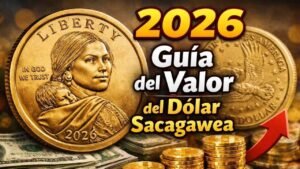
Modern coins can also command extraordinary prices. One of the most dramatic examples is the 2000-P Sacagawea Dollar mule error.
A mule error occurs when mismatched dies are paired during minting. In this case:
- The obverse shows the Sacagawea dollar design
- The reverse mistakenly displays the Washington quarter design
The result is one of the most famous mint errors in modern U.S. history.
Authenticated examples have sold for well over $10,000, with some reaching six figures depending on condition.
These coins are exceptionally rare, but they prove that even 21st-century pocket change can hide astonishing value.
1979-P Susan B. Anthony Dollar Wide Rim
The 1979-P Susan B. Anthony Dollar Wide Rim is a variety worth checking.
When the Susan B. Anthony dollar debuted in 1979, early strikes featured a “wide rim” design where the date appears very close to the edge.
Although not typically a $10,000 coin in average condition, high-grade certified examples can bring significant premiums. Exceptional specimens in top Mint State grades have sold for thousands.
Because millions were produced, this variety is more realistically discoverable in old collections or coin rolls.
2007 Presidential Dollar Missing Edge Lettering
Modern Presidential dollar coins include edge lettering with the year, mint mark, and mottos. However, some early 2007 issues were released without edge inscriptions.
These “missing edge lettering” errors quickly became collector favorites.
While most examples sell in the hundreds or low thousands, pristine, top-grade specimens have reached far higher prices at auction.
Always inspect the edges of Presidential dollars. A blank edge could indicate a valuable error.
How to Evaluate Your Dollar Coins
If you suspect a coin may be valuable, follow these steps:
Check the Date
Certain years — such as 1893, 1889, and 1928 — deserve special attention.
Look for Mint Marks
Letters such as S, CC, D, or P can dramatically change value.
Assess Condition
Coins without scratches, wear, or cleaning marks command stronger premiums.
Search for Errors
Look for doubling, unusual alignment, missing lettering, or odd coloration.
Weigh the Coin
A wrong weight may indicate a planchet error.
If the coin appears promising, consult a professional grading service for authentication and encapsulation.
Why Condition Is Critical
Two identical coins from the same year can differ in value by thousands of dollars based solely on condition.
Collectors rely on a 70-point grading scale. A coin graded MS65 or higher may be worth multiples of the same coin in circulated condition.
Never clean a coin. Cleaning can permanently reduce value and eliminate collector appeal.
Where Valuable Dollar Coins Are Found
Rare coins continue to surface in unexpected places:
- Inherited collections
- Estate sales
- Bank coin rolls
- Safety deposit boxes
- Old coin jars
Many valuable coins are unknowingly spent because owners are unaware of key dates and mint marks.
Final Thoughts
Most dollar coins are worth exactly one dollar. But a small percentage carry substantial premiums due to rarity, condition, or minting errors.
Coins like the 1893-S Morgan, the 1889-CC Morgan, the 1928 Peace Dollar, and the 2000-P Sacagawea mule error have demonstrated that exceptional value can hide in plain sight.
While the odds of finding a $10,000 coin are slim, they are not zero. Knowledge, patience, and careful inspection dramatically improve your chances.
The next time you receive a dollar coin, take a closer look. That small piece of metal might be far more valuable than you think.